
Search rankings can hold steady while clicks fall. When that happens, the first task is to separate a weaker page from a search results page that now answers more of the query. AI Overviews may be part of the change, but blaming every decline on AI leads to the wrong fixes.
A useful response starts with affected queries, not an AI-specific writing formula. Find pages where visibility remains healthy, examine what Google now answers before the click, and give readers a reason to visit that cannot fit inside a summary.
Start with the pattern in Search Console
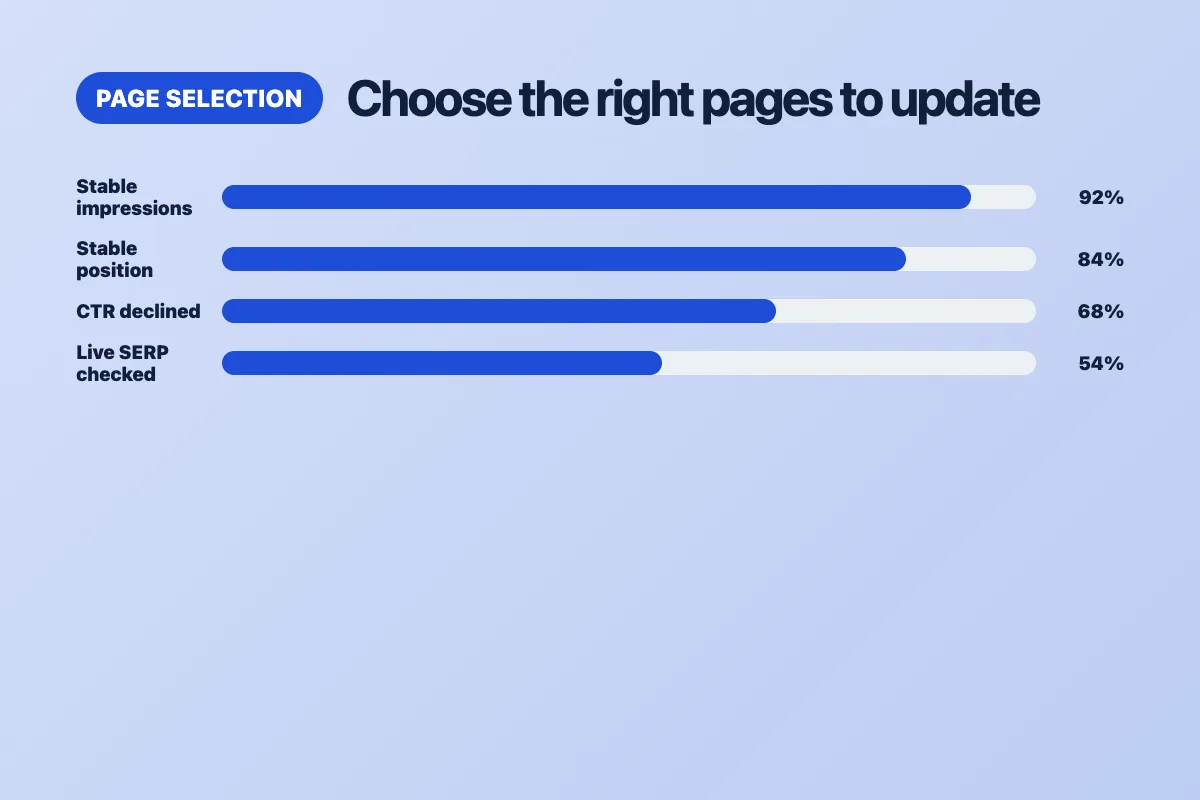
Compare the latest three months with the previous three months at both the query and page level. Look at impressions, clicks, CTR, and average position together. Pages with stable impressions and position but falling CTR are the strongest candidates for a search-results-page change.
A page that lost position and impressions needs a different investigation. Demand may have declined, competitors may have improved, the content may be stale, or indexing may have changed. For seasonal topics, compare the same period year over year before drawing a conclusion.
| What changed | Likely cause | What to check |
|---|---|---|
| Position is stable, CTR falls | AI summaries, SERP features, title competition | Live result page and query intent |
| Impressions and position fall | Content freshness, competition, indexing | URL Inspection, competing pages, update history |
| Impressions fall, position is stable | Search demand or seasonality | Year-over-year data and query trends |
Short-answer pages face the greatest pressure
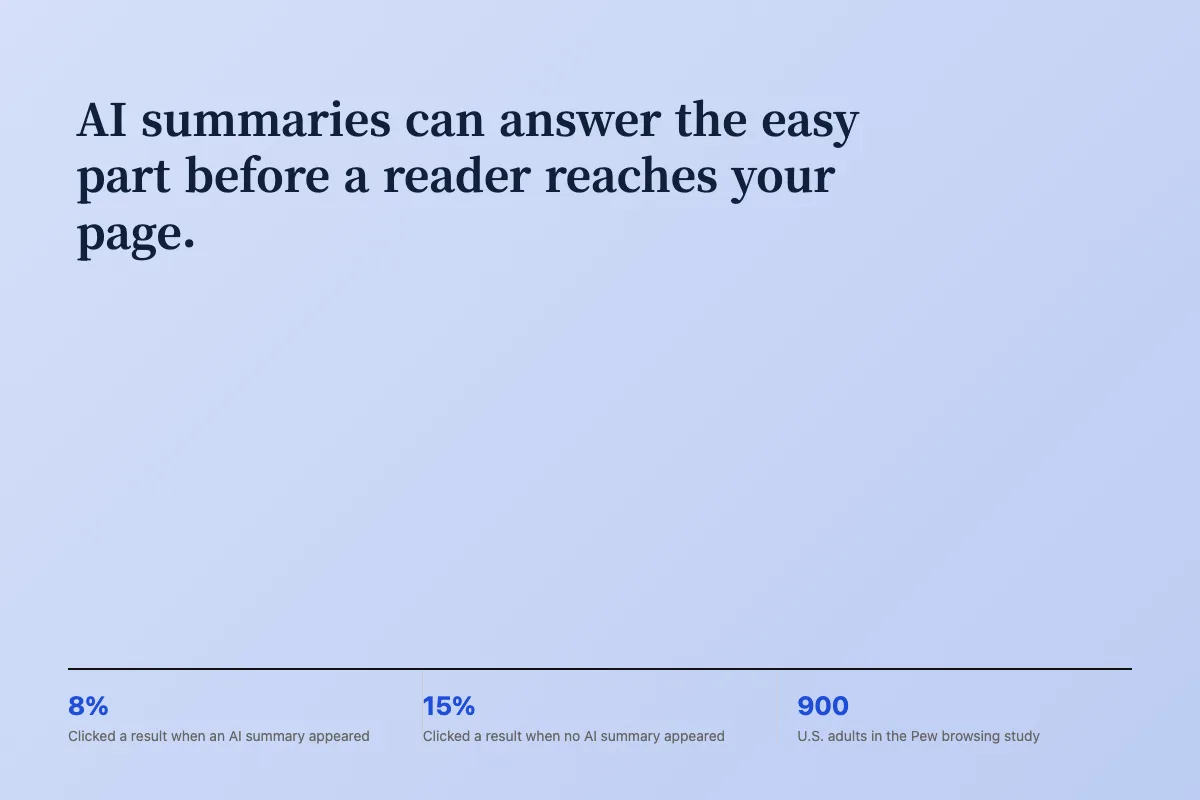
Pew Research Center analyzed browsing data from 900 U.S. adults in March 2025. Users clicked a traditional search result on 8% of visits when an AI summary appeared, compared with 15% when it did not. Links cited inside the summary received clicks on only 1% of visits with an AI summary.
Those figures should not be applied as a universal forecast for every country or website. The audience, query mix, device split, and measurement period matter. The practical signal is narrower: pages that offer only a definition, a short difference, or a basic set of steps are easier to satisfy without a visit.
Long queries are not dead. They need more value after the initial answer. In the same Pew analysis, AI summaries appeared for 53% of searches containing ten or more words and 60% of searches beginning with a question word. Those are precisely the detailed queries publishers often target.
Update pages with existing visibility before rewriting the whole site
Do not begin with a site-wide rewrite. Choose a small group of pages with enough impressions to measure and a clear CTR decline.
- Select five to ten informational pages with stable visibility and lower CTR.
- Search their main queries and record how much of the answer appears on the result page.
- Identify what is missing: decision criteria, screenshots, failure conditions, current pricing, limitations, or a working example.
- Update one group at a time and note the date.
- Compare the result after at least four weeks.
A page titled “What is WordPress caching?” gains little from a longer definition. A plugin comparison, a checklist for changes that do not appear, and a safe cache-clearing sequence give the reader a practical reason to open the page.
AI search still depends on ordinary SEO fundamentals
Google states that no special schema, AI text file, or additional technical requirement is needed for AI Overviews or AI Mode. A page must be indexed and eligible to appear with a snippet. Crawl access, internal links, page experience, visible text, and structured data that matches the page still matter.
Google also says its AI features may use query fan-out, issuing several related searches across subtopics and data sources. That makes a clean topic structure more useful than forcing every related phrase into one page. Publish focused pages, connect them with descriptive internal links, and make the important information available as text.
Give the answer first, then earn the visit
Hiding the basic answer does not create value. State the conclusion early, then add material that a generated summary cannot reproduce reliably for every reader.
The goal is not to make the page longer. It is to make the page useful after the reader already knows the one-sentence answer.
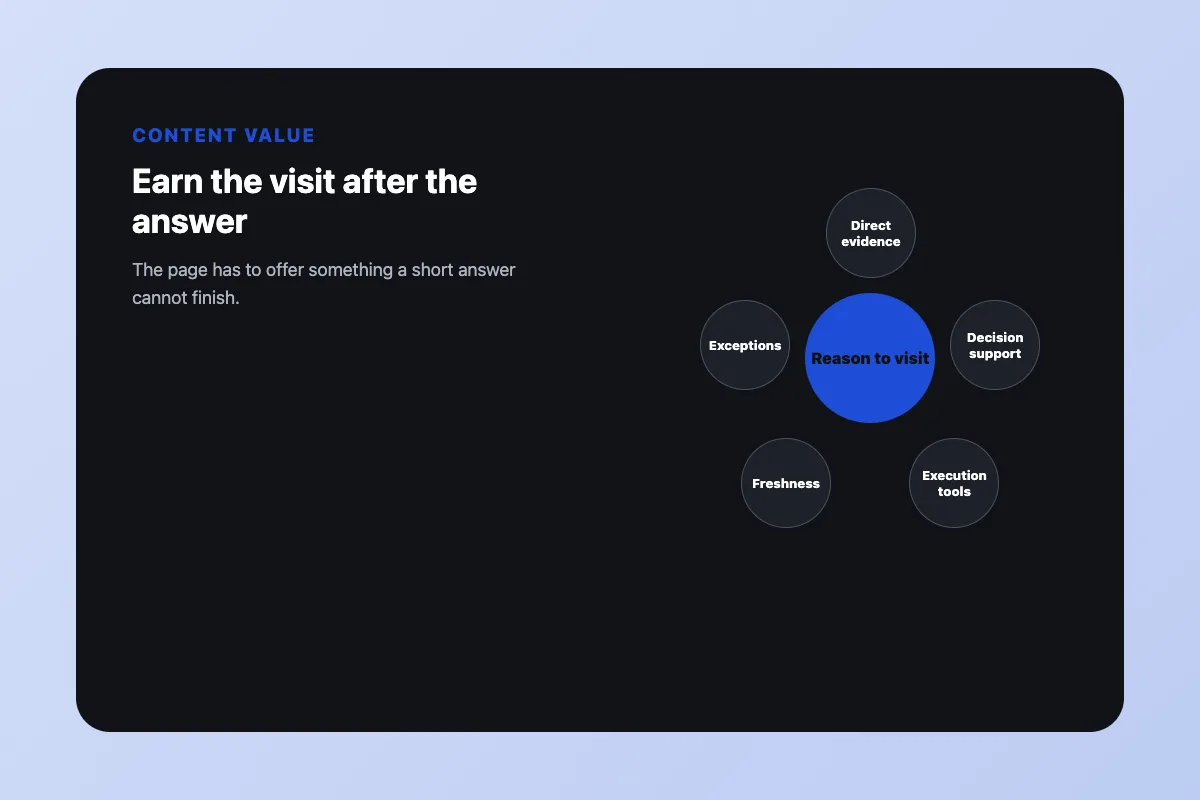
- Direct evidence: real interface states, test results, error messages, and the steps that resolved them.
- Decision support: comparisons, costs, constraints, and recommendations tied to specific conditions.
- Execution tools: checklists, formulas, templates, or verified code readers can use.
- Freshness: the date tested, current menu location, policy changes, and differences from the old method.
- Exceptions: environments where the advice fails, warning signs, and a way to reverse the change.
Build verifiable information blocks, not citation bait
There is no guaranteed sentence pattern for earning an AI Overview citation. A short conclusion under a clear heading helps comprehension, but it does not guarantee visibility. Keep the claim, evidence, and conditions close enough that a reader can evaluate them together.
Instead of writing “this setting improves speed,” record the environment, the before-and-after measurement, and the cache or CDN conditions that affect the result. This structure serves readers even when the page is never cited by an AI feature.
Measure visibility, visits, and outcomes separately
Google reports traffic from AI features inside the Search Console Performance report under the Web search type. In June 2026, Google also began rolling out dedicated generative AI performance reports to a subset of websites. The reports show impressions as well as the pages, countries, devices, and dates associated with visibility in generative AI features.
If the dedicated report is not available for your property, query and page comparisons still work. Pair Search Console data with engagement and conversion data from analytics. Fewer visits are not automatically a business failure if the remaining visitors subscribe, enquire, or buy at a higher rate.
| Metric | Question it answers |
|---|---|
| Impressions | Is the page still being surfaced? |
| CTR | Are fewer impressions turning into visits? |
| Average position | Did the click loss arrive with a ranking loss? |
| Engagement | Do visitors use the page after arriving? |
| Conversions | Does the visit lead to a meaningful action? |
Run a focused 30-day test
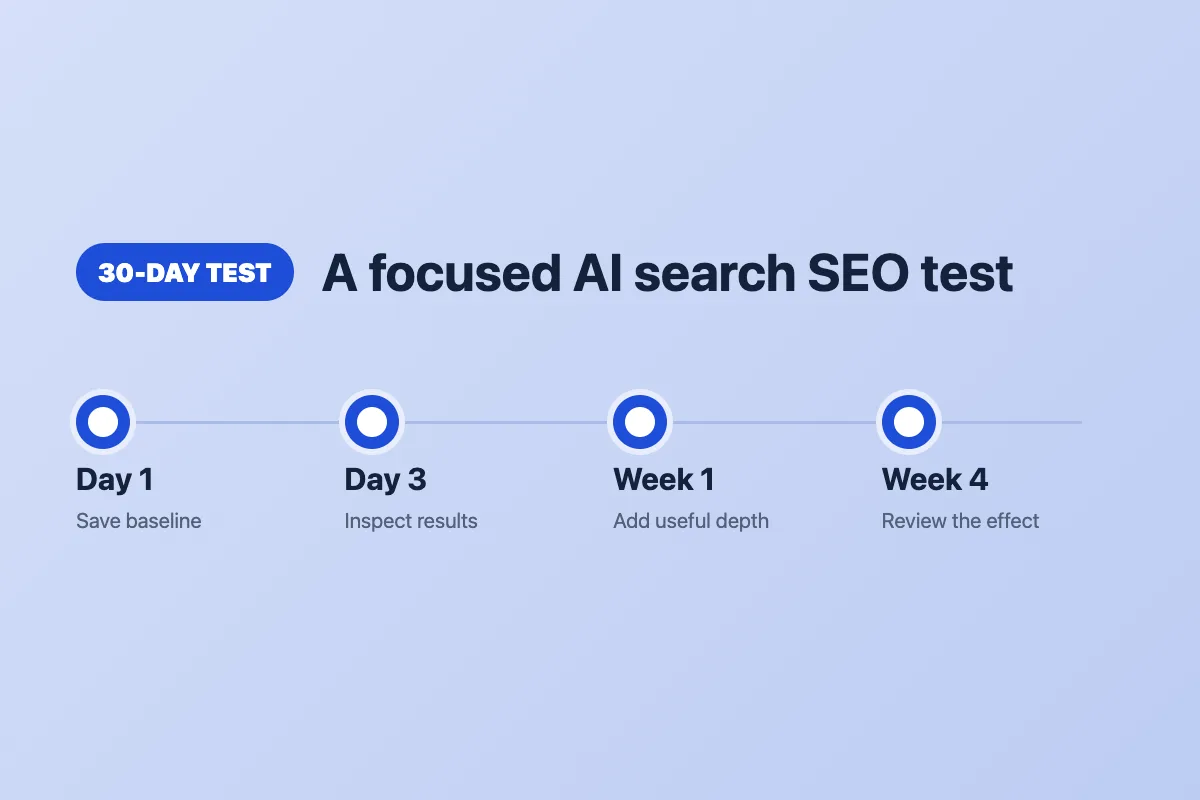
Choose five to ten pages that serve a similar search intent. Save the baseline, improve the reasons to visit, and leave a comparable set unchanged. The unchanged pages help separate the effect of your edit from a broader decline in search demand.
- Record impressions, position, CTR, engagement, and conversions.
- Check the live search result for each target query.
- Add evidence, decision criteria, exceptions, or an execution tool.
- Improve internal links and record the publication date.
- Review the group after four weeks rather than reacting to daily movement.
SEO for AI search is not a race to collect citations. It still involves being discoverable, earning the visit, and helping the visitor complete a useful next step. The first win is choosing the right pages to change.
Use benchmark click rates carefully
Click behavior varies by country, query mix, device, and study period. Use the published research to understand the direction of change, then make decisions from your own Search Console and analytics data.
Frequently asked questions
Does AI Overview make blog SEO pointless?
No. Google’s AI features still rely on indexed pages and standard SEO foundations. The change is that a page needs to offer more than a short answer that can be completed on the search results page.
Do I need special schema for AI Overviews?
No. Google says there is no special AI schema or machine-readable file required. Existing structured data should accurately match the visible content.
Will answering the query early reduce clicks?
Hiding the answer is unlikely to create durable value. Give the basic conclusion early, then provide evidence, comparisons, tools, and exceptions that make the full page worth opening.
Can I measure AI search traffic in Search Console?
AI feature traffic is included under the Web search type in the main Performance report. Google began testing dedicated generative AI visibility reports with a subset of sites in June 2026.
How many old posts should I update first?
Start with five to ten pages that have similar intent, meaningful impressions, and a measurable CTR decline. Record a baseline and review the group after at least four weeks.