
If you’ve been defaulting to GPT models inside Cursor, the model picker in your editor might look pretty different soon.
OpenAI has officially announced it will end its model supply agreement with Cursor. That said, GPT isn’t disappearing today — the currently proposed end date is November 12, 2026, and Cursor says it’s still in talks with OpenAI.
Why is OpenAI cutting off Cursor’s model supply?
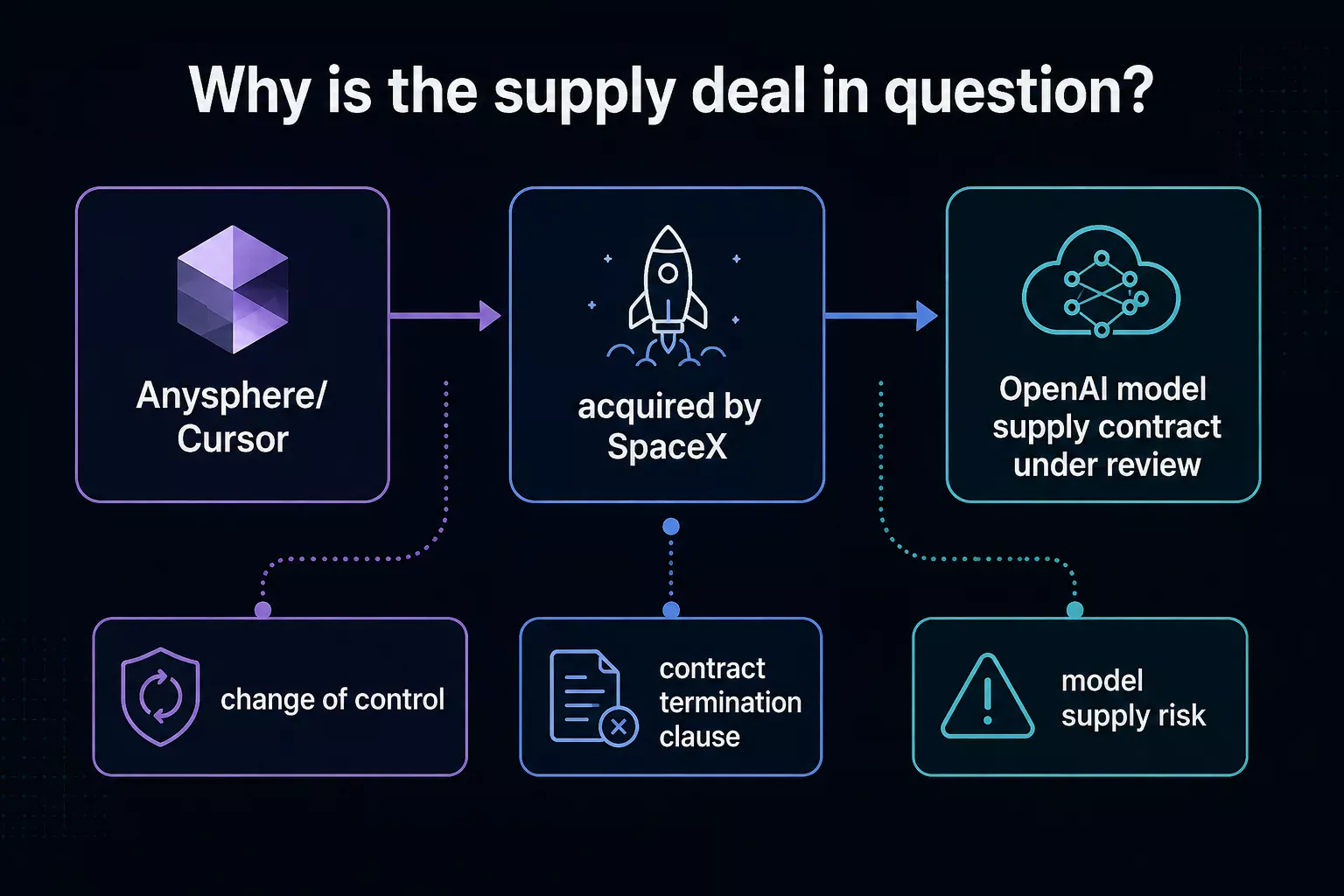
The real story here isn’t about anything wrong with Cursor itself — it’s an ownership change.
Anysphere, the company behind Cursor, was acquired by SpaceX in August 2026. OpenAI says its contracts include a clause letting it terminate a deal within a set window whenever a change of control happens.
The specific issue OpenAI flagged is SpaceX’s ties to Elon Musk-affiliated companies.
OpenAI said that Musk-acquired companies have previously violated its terms of service or contracts, and it can’t be confident SpaceX will use OpenAI’s technology in line with contract terms going forward.
So the center of this situation is a model supply contract, not anything about Cursor’s features or performance.
Will GPT stop working in Cursor on November 12?
It’s too early to say that for certain.
The date OpenAI announced is currently a proposed end date. Cursor co-founder Michael Truell told Reuters the company is still in discussions with OpenAI to resolve the issue.
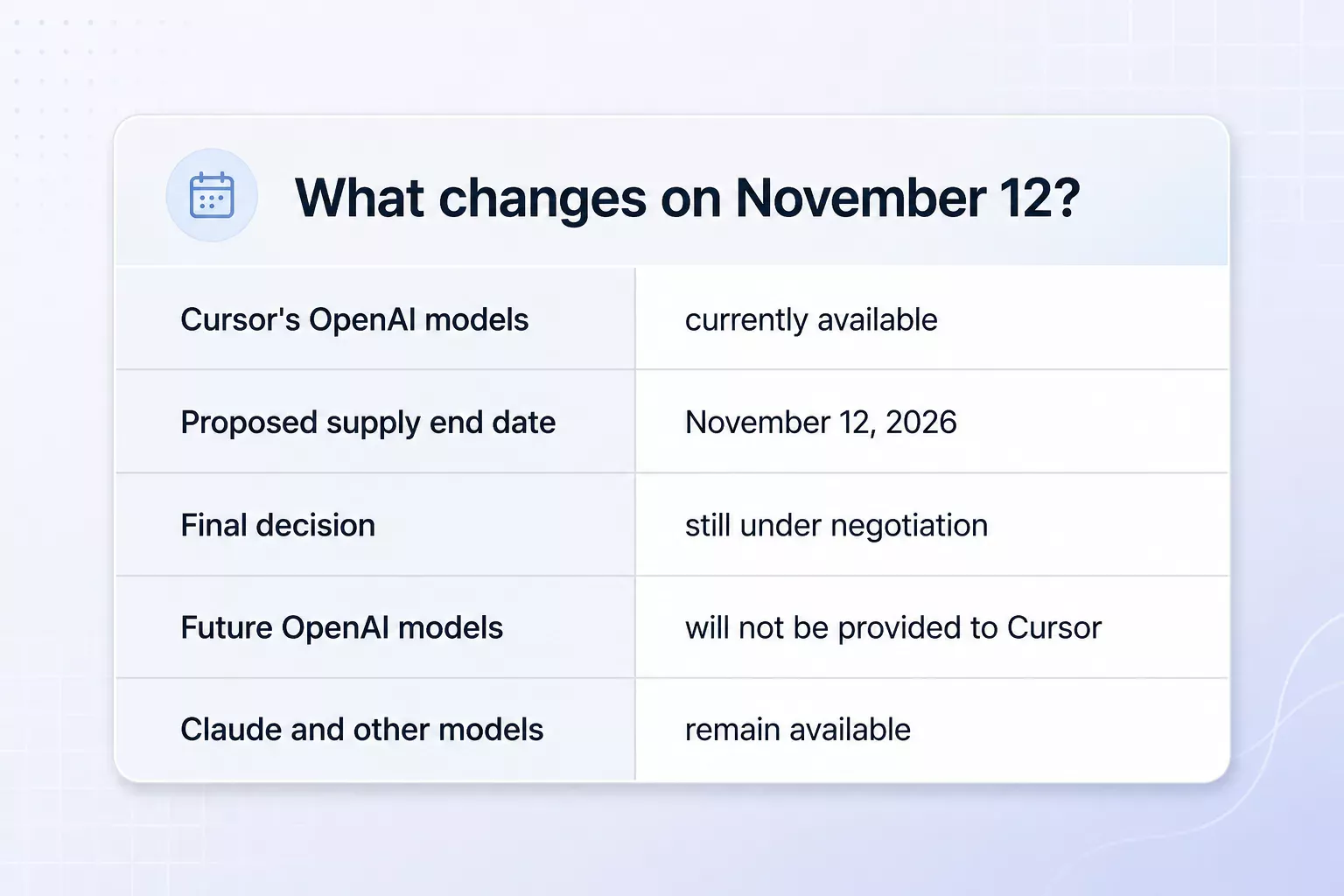
Here’s where things stand right now.
One part matters more than the current lineup of models: what comes next.
OpenAI has said that, separate from whether the current contract ends, it does not plan to give Cursor access to its future models going forward. For Cursor users who were counting on next-generation models, this might end up being the bigger change.
| Item | Current status |
|---|---|
| Cursor’s OpenAI models | Working normally |
| Proposed supply end date | November 12, 2026 |
| Final decision | Still under negotiation |
| Future OpenAI models | Will not be provided to Cursor |
| Claude and other models | Remain available |
Losing GPT doesn’t mean losing Cursor
If you’ve been thinking of Cursor and GPT as basically the same thing, this news might feel bigger than it actually is.
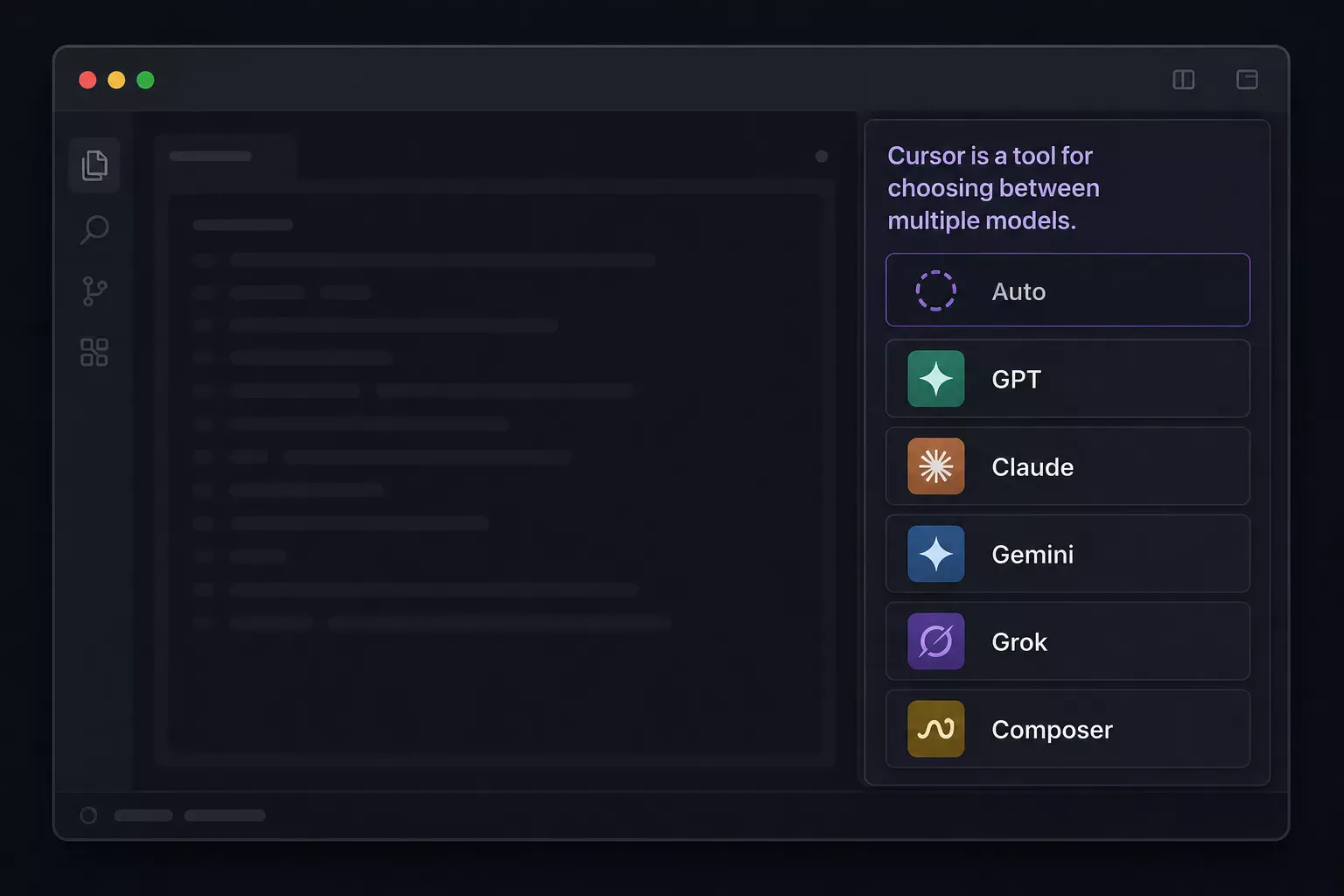
In practice, Cursor is closer to a development tool that connects to multiple AI models.
Cursor’s own documentation currently lists OpenAI’s GPT family alongside Anthropic’s Claude, Google’s Gemini, Grok, and Cursor’s own Composer model. You can pick a model yourself depending on the task, or let the Auto feature choose for you.
So even if OpenAI’s supply genuinely ends, Cursor itself doesn’t stop working.
What changes is which AI engine is doing the work.
Can Claude just replace GPT?
If Grok’s output hasn’t been winning you over, Claude is one of the more realistic alternatives.
Anthropic said, following OpenAI’s announcement, that it’s expanding compute support so Claude works well inside Cursor. Cursor already lets you pick Claude Sonnet and Opus-tier models today.
That doesn’t mean you need to switch every project to Claude immediately, though.
Each model handles code generation, the scope of edits, and understanding a large codebase a bit differently. If you’ve spent time fine-tuning GPT-specific prompts or Cursor Rules, switching models can change your results.
For anything that matters, it’s worth running the same task through both GPT and Claude now and comparing the actual output, rather than assuming the switch will be seamless.
Can I just plug in my own OpenAI API key?
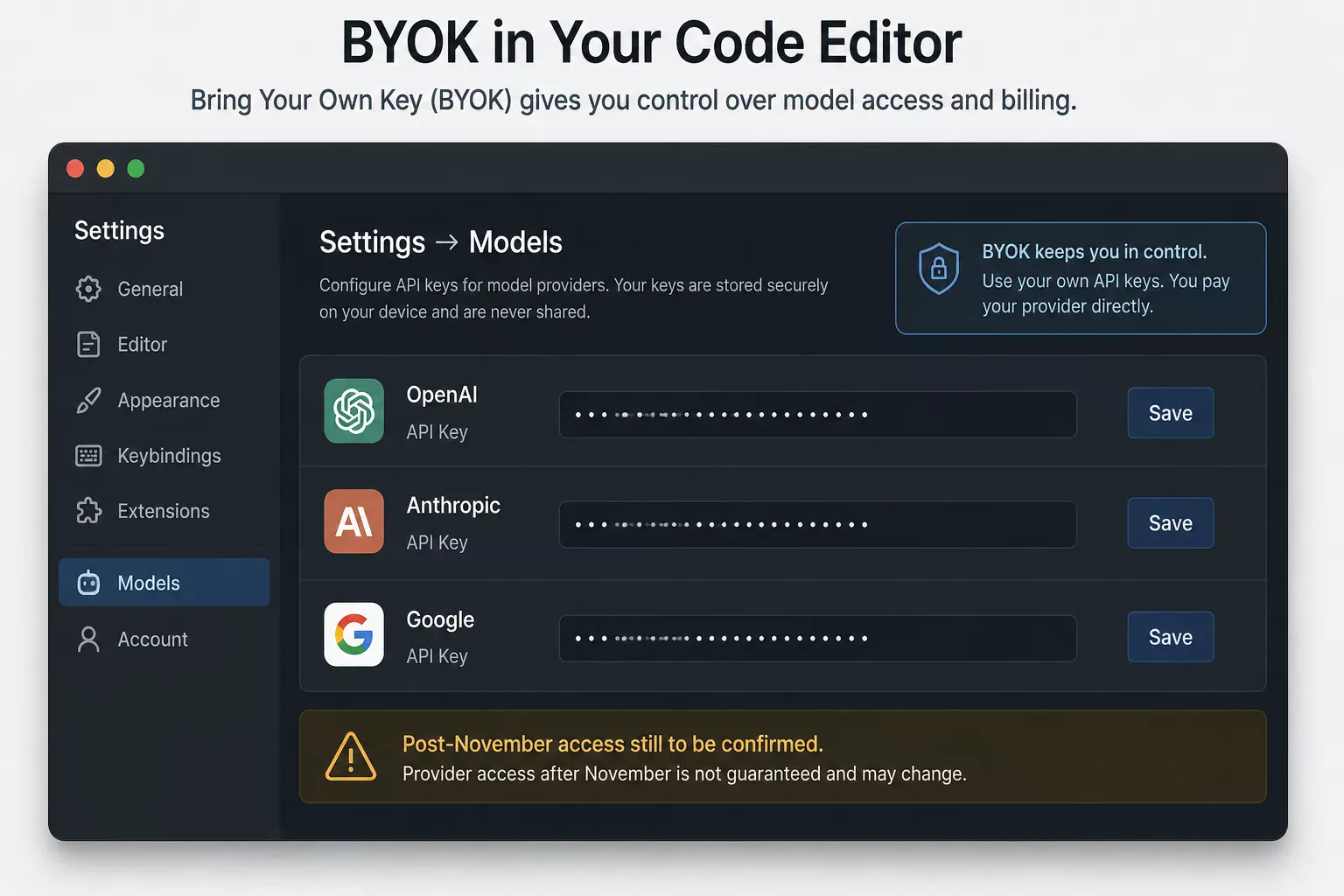
Cursor already supports BYOK — bringing your own API key for OpenAI, Anthropic, Google, and others — through `Settings → Models`.
But don’t treat this as a guaranteed workaround for the supply cutoff.
OpenAI’s announcement is specifically about ending its model-supply agreement with Cursor. It hasn’t spelled out how much personal OpenAI API key access will still work inside Cursor after November.
So whether using your own API key keeps working is another thing you’ll need to confirm from Cursor and OpenAI’s future updates.
What should Cursor users actually do right now?
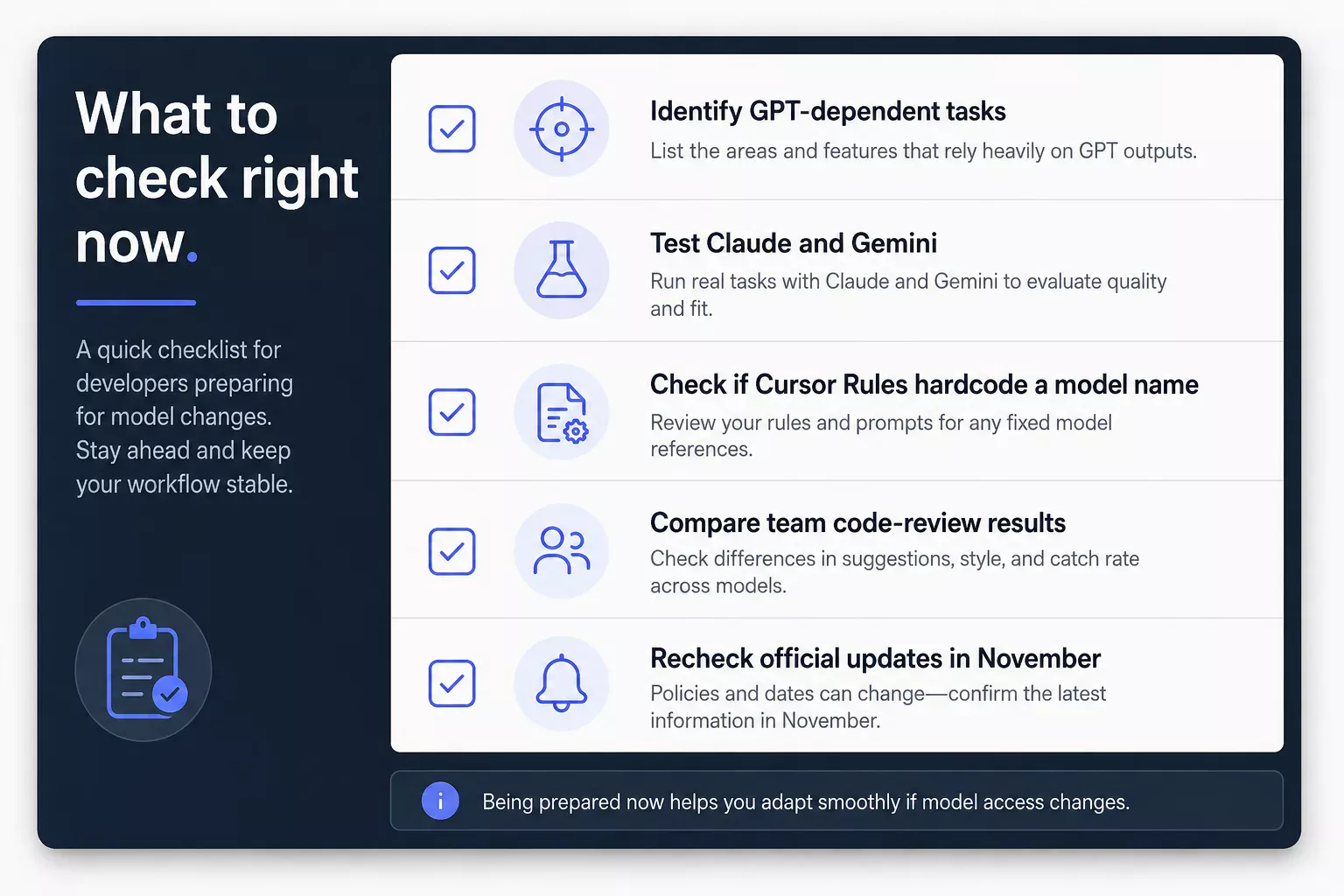
There’s no need to abandon Cursor or overhaul your whole project setup today.
A more useful move is to use the time before November to figure out how dependent your current workflow actually is on GPT.
Try your regular tasks on Claude, Gemini, or Cursor’s own model, and check whether a specific model name is hardcoded anywhere in your Cursor Rules or automation scripts.
This matters even more if you’re using Cursor on a team, since a model switch can change code review outcomes or the style of generated code.
What this whole situation really exposes is an underappreciated weak point in AI coding tools.
Choosing an editor doesn’t permanently lock in the AI model running inside it. A tool like Cursor, which connects to models from multiple companies, can have its available features shift depending on model supply contracts between those companies.
Going forward, when picking an AI development tool, it’s worth looking not just at which model performs best today, but at how easily you could move to a different one if you had to.
Before you read further
As of August 30, 2026, OpenAI has announced its intent to end model supply to Cursor, but the actual end date is still weeks away. The timeline and which models remain available could change depending on how the negotiation goes.
Frequently Asked Questions
Is GPT already gone from Cursor?
No. OpenAI’s models still work in Cursor right now. The proposed contract end date OpenAI announced is November 12, 2026.
Will GPT definitely disappear on November 12?
Not confirmed yet. OpenAI proposed that date as the contract end point, but Cursor has said it’s still in active discussions with OpenAI.
If GPT goes away, can I still use Cursor?
Yes. Cursor supports Claude, Gemini, Grok, and its own Composer model, so you can keep working with a different model.
Is bringing my own OpenAI API key a safe workaround?
It’s uncertain. Cursor currently supports BYOK, but OpenAI hasn’t specified how personal API key access will work after the contract ends.
Should I switch to Claude right now?
There’s no need to rush. But if you have important work that depends heavily on GPT, it’s worth testing the same task on Claude or another model now.